
Where should this patient go, and did they get there?
The referral loop is the complete path from the moment a provider decides where care should happen next to a booked appointment with the right in-network specialist. Referral orchestration is the deliberate work of managing every step of that path.
In most health systems, where a patient should go and whether they got there have never shared an answer. The network strategy team owns the first. The patient access team owns the second. Neither can see what the other sees, and the gap between them is where patients are lost.
Clarify Meridian answers the first question. Clarify Arrival answers the second, across every path a patient takes into the system. Both run on the Clarify Atlas Platform, which maps more than 300 million lives and 20 billion data points, so each half of the loop draws from the same intelligence.
What is the referral loop?
The referral loop is the complete sequence connecting a care decision to a completed appointment. It runs through five stages: network strategy, referral decision, scheduling, care completion, and outcome measurement.
Traditional referral management focuses on the middle of that sequence. Referral orchestration connects the front end, where network decisions are made, with the back end, where outcomes are measured. That distinction matters because a referral placed is not an appointment scheduled, and an appointment scheduled is not care completed.
Where the loop breaks
A Duke University study published in the Journal of General Internal Medicine examined 103,737 attempts to schedule specialist appointments from primary care referrals at one large health system. Only 34.8% resulted in a documented completed appointment, so nearly two in three did not. Another 38.9% had no documented appointment date at all. Of those, 52.2% were in-network referrals.
The larger problem is visibility. Without a clear picture of referral outcomes, health systems cannot distinguish between patients who completed care, patients who hit an access barrier, and patients whose care quietly moved out of network. For strategy leaders, that uncertainty complicates growth planning. For patient access teams, it hides where scheduling breaks down.
The network decision: Clarify Meridian
Before a patient can reach the right specialist, a health system needs to know which referral decisions are worth influencing and which physicians are movable. That is the work Clarify Meridian does.
Meridian connects four stages: the intelligence to know where growth is available, the plan that ranks every referring practice by addressable opportunity, the activation that puts playbooks into your CRM before every field visit, and the outcome measurement that tracks volume moved against the same baseline the fee is calculated from.
The standard for ranking a physician practice is not volume. It is addressability: the fraction of leaked opportunity that the field team can actually shift, based on referral behavior from claims, verified competitor ties, the driver behind each leak, and the quality case for the in-network alternative. A high-volume practice that cannot be moved sits below a smaller one that can. That distinction is what makes the target list actionable.
Quality comes first. Every specialist in the market is scored, and a redirect is only recommended where the in-network alternative clears the quality threshold and out-scores the outside option. That includes a health system's own specialists. The case has to hold before anyone walks into the practice.
The patient half: Clarify Arrival
Knowing where care should go is not the same as getting the patient there. Clarify Arrival closes the second half of the loop. It sees every path a patient takes into the health system and carries each one through to a booked in-network appointment.
Arrival works across three paths. The first is the referral waiting to be scheduled: a physician has decided where care should go, and Arrival carries that referral through scheduling to a booked visit. The second is the open care gap: a patient who needs follow-up care and has not been reached. Arrival identifies them before they fall out of care and reaches them through targeted outreach. The third is the patient searching for a provider online, whom Arrival matches in real time to in-network options with the availability and coverage that fit.
Every path ends at the same place: a booked in-network appointment. That is the only outcome Arrival counts.
Frederick Health, a 269-bed system in Frederick County, Maryland, deployed Clarify Arrival on the search path. Provider searches grew 83%. Nearly half of chatbot conversations led to a next step. The chatbot handled more than 15,000 patient messages in 12 months.
Meridian activates the physician. Arrival activates the patient. Together, they complete the loop.
The shared foundation: Clarify Atlas Platform
Connecting network strategy with patient activation requires a consistent foundation. The Clarify Atlas Platform provides it.
With intelligence drawn from more than 300 million lives and 20 billion data points, Atlas informs both products from the same source. Meridian uses it to identify leakage and prioritize physicians. Arrival uses it to steer referrals, outreach, and search to the right in-network provider on quality, timeliness, and affordability. The result is that every recommendation Arrival makes reflects the same market picture Meridian was built on, and every outcome Meridian measures reflects whether Arrival's activation actually produced care.
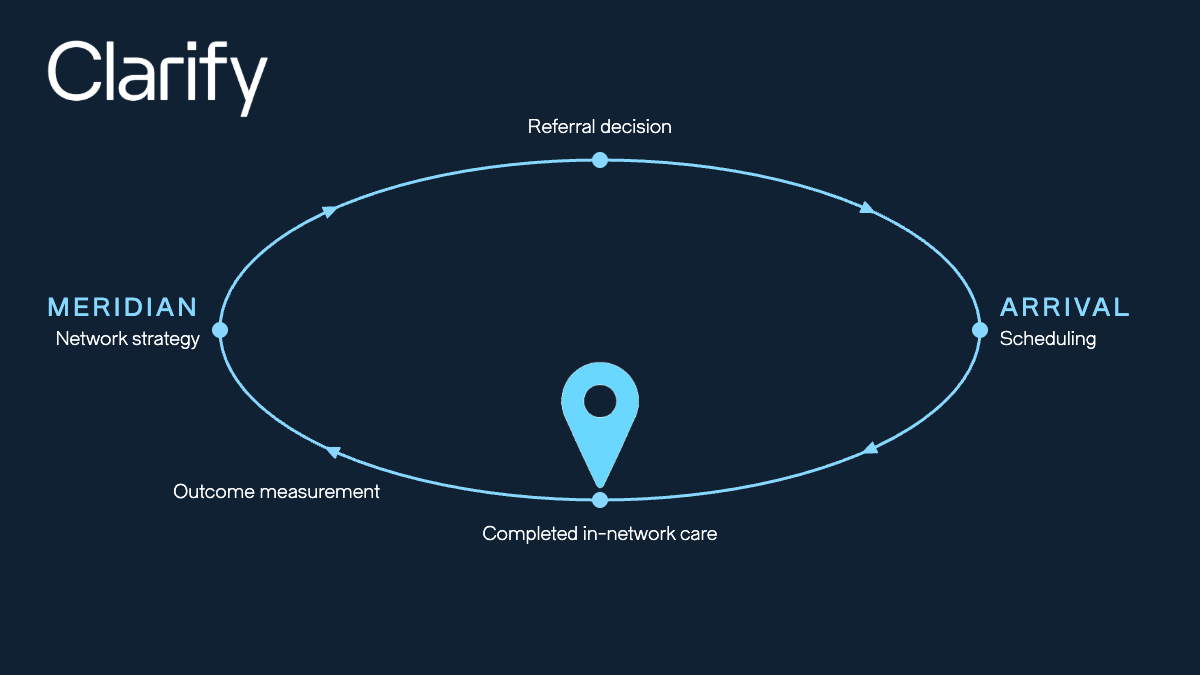
From network opportunity to completed in-network care, Clarify Meridian and Clarify Arrival connect both halves of the referral loop, powered by the Clarify Atlas Platform.
How health systems should measure the referral loop
Referral volume alone does not tell a health system whether its network is performing. Measuring the loop requires visibility across each stage: referral volume and in-network rate, appointment scheduling rate, completed care rate, referral leakage by payer and corridor, and network growth outcomes tied to specific physician activation efforts.
A rising in-network referral rate does not automatically mean access improved. A higher scheduling rate does not mean patients completed care. The goal is understanding how decisions, access, and outcomes connect, so the health system can identify where the loop is breaking and act on it.
FAQ
What is the referral loop in healthcare?
The referral loop is the complete path from a provider's care decision to a booked appointment with the right in-network specialist. Closing the loop means confirming that care happened and making that outcome visible to the referring team.
What is referral orchestration in healthcare?
Referral orchestration is the coordinated management of referral decisions, provider selection, scheduling, and downstream outcomes. It connects what a health system decides with whether that decision produced care.
How do Clarify Meridian and Clarify Arrival work together?
Clarify Meridian identifies where care should go and activates the physician relationships that support it. Clarify Arrival converts that intelligence into booked in-network appointments across three paths: the referral waiting to be scheduled, the patient who needs outreach before they fall out of care, and the patient searching for a provider on their own. Together they address both halves of the referral loop, from network strategy through patient arrival.
What is the Clarify Atlas Platform?
The Clarify Atlas Platform is the shared healthcare intelligence foundation beneath both Meridian and Arrival. It brings together intelligence from more than 300 million lives and 20 billion data points to inform network strategy, provider recommendations, and patient activation.
Why does referral loop measurement matter?
A referral placed is not care completed. Measuring each stage helps health systems distinguish between scheduling failures, access barriers, and out-of-network leakage, so they can target interventions where they will have the most impact.
Research reference
Patel MP, et al. Closing the Referral Loop: an Analysis of Primary Care Referrals to Specialists in a Large Health System. Journal of General Internal Medicine. 2018;33(5):715-721. https://doi.org/10.1007/s11606-018-4392-z